Stories
Zakariyya and the Glad Tidings of Yahya
The account of a prophet who reached extreme old age without letting go of hope: Zakariyya, peace be upon him, who lived from the work of his own hands and stood in prayer in the sanctuary of Jerusalem. Entrusted with the care of Maryam, he found provision with her that no ordinary cause explained, and a private supplication stirred in his heart: my Lord, grant me from Yourself a good offspring. The glad tidings came of Yahya, a name never given to anyone before him, and the sign was that he would not speak to people for three days except by gesture, only remembrance and praise. Then the boy was born who was given sound judgement while still young and who was dutiful to his parents.

Recitation audio comes from verified reciters. AI-generated voice is never used for Quran recitation.
Chapter 1
A Man Who Ate From His Own Labour

In Jerusalem, at a time when the Children of Israel were divided between scholars who preserved the Scripture and ordinary people busy with their livelihood, there was a man who served the sanctuary by day and returned to his workshop to labour with his hands. Zakariyya, peace be upon him, was not a prophet living on what people gave him. He was a carpenter who ate from what he earned. An authentic narration states it plainly: Zakariyya was a carpenter. That small detail opens the door to understanding his whole character.
A man who holds a saw and knows the weight of timber in his hands also knows what it means to be patient with something that is not finished in a day. Carpentry is cumulative work. It gives no quick result and rewards only the one who returns to the bench every morning. This is precisely how he would later describe himself before his Lord: a servant whose supplication never lapsed across a long lifetime.
Allah opened his account in Surah Maryam with an introduction that names the genre of the story before it is told:
Open surahSurah Maryam 19:2
Verified recitation
[This is] a mention of the mercy of your Lord to His servant Zechariah
[This is] a mention of the mercy of your Lord to His servant Zechariah
The title the Quran gives is not "an answered prayer" nor "a miracle that happened" but a mention of mercy. That framing matters: everything that follows, the tidings, the birth, the sign, all of it branches from one root called mercy, not from entitlement and not from coincidence.
Between the sanctuary and the workshop a balanced life took shape: fulfilling the right of Allah in worship, the right of the self in earning, and the right of people not to be burdened by him. From this quiet ground the greatest moment of his life would later grow.
Lessons
- Working with one hand does not lower a servant in the sight of Allah
- Patience with work that is not finished in a day trains the heart for long supplication
- The Quran called the account a mention of mercy before mentioning the tidings
Chapter 2
The Care of Maryam and Provision Without a Cause
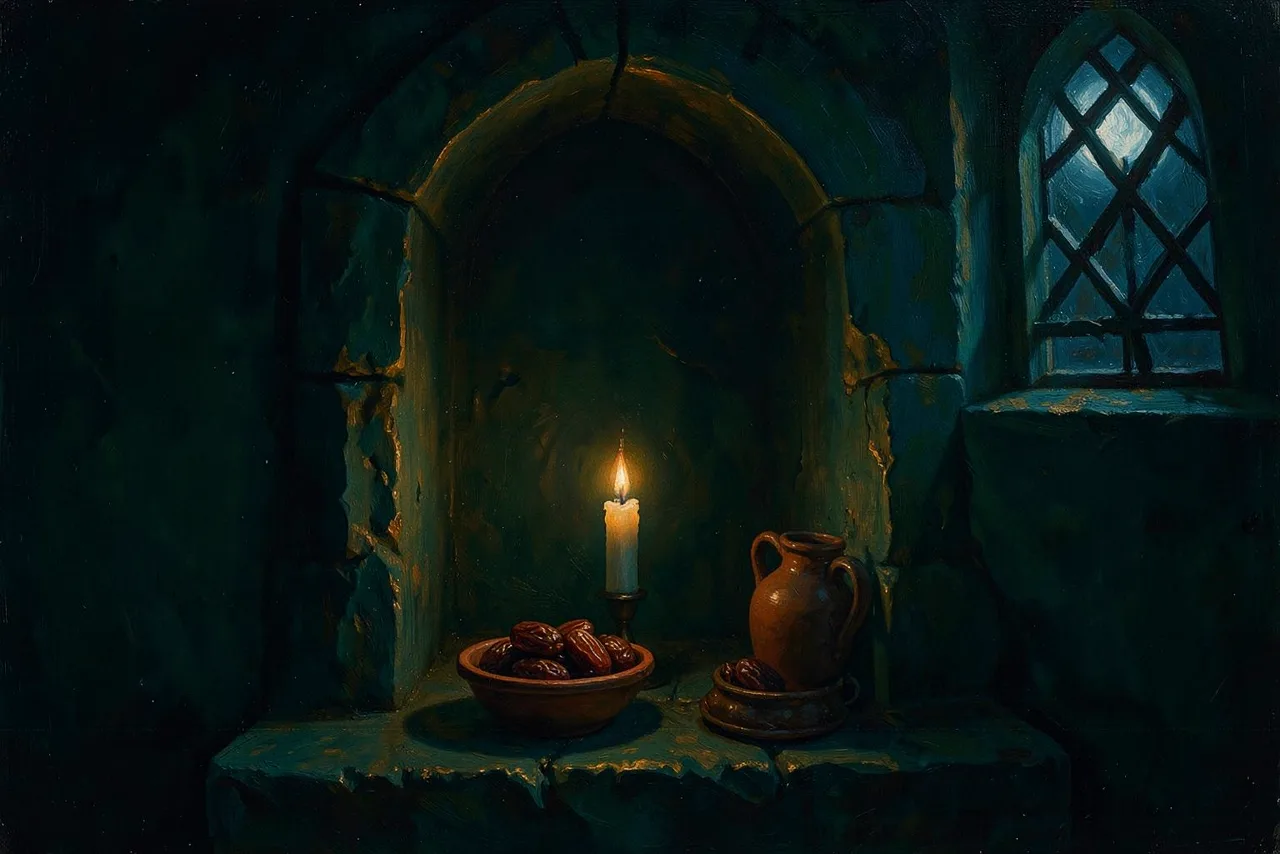
When Maryam was dedicated to the service of the sanctuary, the people competed over her care, and the lot fell to Zakariyya, peace be upon him. This was not an administrative detail in the story. It was the doorway that reopened hope for him just as it was about to close.
He would enter upon her in the prayer chamber and find food whose origin he did not know. No door had been opened, no hand had carried it, no visible cause could be pointed to. Allah says:
Open surahSurah Ali 'Imran 3:37
Verified recitation
So her Lord accepted her with good acceptance and caused her to grow in a good manner and put her in the care of Zechariah. Every time Zechariah entered upon her in the prayer chamber, he found with her provision. He said, "O Mary, from where is this [coming] to you?" She said, "It is from Allah. Indeed, Allah provides for whom He wills without account."
So her Lord accepted her with good acceptance and caused her to grow in a good manner and put her in the care of Zechariah. Every time Zechariah entered upon her in the prayer chamber, he found with her provision. He said, "O Mary, from where is this [coming] to you?" She said, "It is from Allah. Indeed, Allah provides for whom He wills without account."
Her answer was itself the lesson: it is from Allah. A short sentence, yet it removed a constraint that had been governing his thinking, the assumption that a gift can only arrive through a known channel. If food could come without a visible cause, why should a child be impossible simply because the visible cause had ended?
Here the scene turned from observation into supplication. He did not merely marvel, nor stop at reflection. He carried what he saw in the chamber into his heart and then onto his tongue:
Open surahSurah Ali 'Imran 3:38
Verified recitation
At that, Zechariah called upon his Lord, saying, "My Lord, grant me from Yourself a good offspring. Indeed, You are the Hearer of supplication."
At that, Zechariah called upon his Lord, saying, "My Lord, grant me from Yourself a good offspring. Indeed, You are the Hearer of supplication."
Notice the precision of the request: a good offspring, not offspring alone. He did not ask for number, strength or beauty. He asked for righteousness. He qualified it with from Yourself, meaning from You without the mediation of causes that had run out. And he sealed it with the praise that opens doors: indeed You are the Hearer of supplication.
The word at that in the verse marks time and place: there, in that moment. The supplication was born from a scene he witnessed, not from emptiness. That is how looking at Allah's favour upon someone else can become a door to hope rather than to envy.
Lessons
- Seeing Allah provide for someone else can open hope rather than envy
- A specific request is nobler than a vague one: he asked for a good offspring, not merely offspring
- Saying from Yourself acknowledges that a gift is not limited by the failure of ordinary causes
Chapter 3
A Private Call No One Heard

He could have raised his voice so people knew he was praying, or made his need a topic in gatherings. He chose another way. Allah says:
Open surahSurah Maryam 19:3
Verified recitation
When he called to his Lord a private supplication.
When he called to his Lord a private supplication.
Describing the call as private is not a decorative detail. Concealment is courtesy before Allah, and it also protects supplication from becoming display. Whoever hides his need from people has declared that he expects nothing from them.
Then he began to describe his state without embellishment or exaggeration:
Open surahSurah Maryam 19:4
Verified recitation
He said, "My Lord, indeed my bones have weakened, and my head has filled with white, and never have I been in my supplication to You, my Lord, unhappy.
He said, "My Lord, indeed my bones have weakened, and my head has filled with white, and never have I been in my supplication to You, my Lord, unhappy.
See the order of his words: weakness in the bones, whiteness spreading over the head until it resembles a flame, then a long record of supplication that had never left him disappointed. He places before his request a history, not an excuse: I have never called upon You before and been turned away.
As for the reason behind the request, he stated it openly:
Open surahSurah Maryam 19:5
Verified recitation
And indeed, I fear the successors after me, and my wife has been barren, so give me from Yourself an heir
And indeed, I fear the successors after me, and my wife has been barren, so give me from Yourself an heir
His fear was not for wealth to be inherited or status to be preserved, but for knowledge and religion falling into hands that would not honour them. So he specified exactly what he wanted:
Open surahSurah Maryam 19:6
Verified recitation
Who will inherit me and inherit from the family of Jacob. And make him, my Lord, pleasing [to You]."
Who will inherit me and inherit from the family of Jacob. And make him, my Lord, pleasing [to You]."
The inheritance intended is prophethood, knowledge and righteousness, not possessions, as the commentators state. Then he added a final condition: make him pleasing to You, because a child who is not pleasing to Allah becomes a trial rather than a gift.
In Surah Al-Anbiya the same scene appears in briefer and even more intimate wording:
Open surahSurah Al-Anbya 21:89
Verified recitation
And [mention] Zechariah, when he called to his Lord, "My Lord, do not leave me alone [with no heir], while you are the best of inheritors."
And [mention] Zechariah, when he called to his Lord, "My Lord, do not leave me alone [with no heir], while you are the best of inheritors."
This is among the greatest words to say in loneliness: do not leave me alone. Then he followed it with what keeps supplication from becoming attachment to creation: while You are the best of inheritors. If You do not grant me an heir, You remain, and if You do grant one, the favour is Yours. He asks intensely and surrenders at the same moment.
Lessons
- Concealing supplication is courtesy before Allah and protects it from display
- Supplication begins with an honest description of your state, not a polished one
- Fearing for knowledge and religion is nobler than fearing for wealth
- Saying You are the best of inheritors keeps supplication from turning into attachment to creation
Chapter 4
Tidings of a Name No One Had Borne
The answer came not after years of silence but in the very place where he had prayed, while he was standing in prayer. Allah says:
Open surahSurah Ali 'Imran 3:39
Verified recitation
So the angels called him while he was standing in prayer in the chamber, "Indeed, Allah gives you good tidings of John, confirming a word from Allah and [who will be] honorable, abstaining [from women], and a prophet from among the righteous."
So the angels called him while he was standing in prayer in the chamber, "Indeed, Allah gives you good tidings of John, confirming a word from Allah and [who will be] honorable, abstaining [from women], and a prophet from among the righteous."
The tidings did not carry a name alone but four descriptions that defined this child's role before his birth: confirming a word from Allah, meaning Isa, peace be upon him; honourable, one whom people would follow; restrained, master of his own desires; and a prophet among the righteous. The father had asked for a righteous child, and the answer told him the child would exceed what he asked.
In Surah Maryam the call comes in closer and warmer form, with the father's name spoken directly:
Open surahSurah Maryam 19:7
Verified recitation
[He was told], "O Zechariah, indeed We give you good tidings of a boy whose name will be John. We have not assigned to any before [this] name."
[He was told], "O Zechariah, indeed We give you good tidings of a boy whose name will be John. We have not assigned to any before [this] name."
The name was not left to the parents to choose, as with every other child. Allah named him before he existed: Yahya. And He announced that no one had borne that name before him, an indication of the uniqueness of the mission he would carry, and that this gift was not a repetition of an earlier one.
The meaning of the name itself is striking. Yahya comes from life. A child arrived after hope in the chain of ordinary causes had died, so his very name announced that Allah gives life to whatever He wills whenever He wills. From this the commentators understood the phrase We have not assigned to any before this name as uniting a unique name with a unique circumstance.
At this moment the phrase a mention of mercy, with which the surah opened the account, becomes complete. The supplication was private, the answer came in the sanctuary. The request was a few words, the gift arrived described by four qualities. This is what distinguishes divine giving from every other kind of giving: it comes larger than the request.
Lessons
- The answer came in the place of worship, not away from it
- Allah named Yahya before he existed, and the unique name pointed to a unique mission
- Divine giving arrives wider than the boundaries of the request
Chapter 5
How Can I Have a Boy

Zakariyya, peace be upon him, asked a question that some readers take for objection when it is in fact an inquiry into the manner, not a doubt about the power. Allah says:
Open surahSurah Maryam 19:8
Verified recitation
He said, "My Lord, how will I have a boy when my wife has been barren and I have reached extreme old age?"
He said, "My Lord, how will I have a boy when my wife has been barren and I have reached extreme old age?"
The Arabic word rendered as extreme old age conveys reaching the limit of dryness, like a branch so dried out that no suppleness remains in it. He describes himself with utmost precision: nothing in his body remained that could lead to a child. And his wife was barren, having never borne a child in her youth or after it. The obstacle was double and complete.
So the answer came not by detailing the method but by reminding him of a greater principle:
Open surahSurah Maryam 19:9
Verified recitation
[An angel] said, "Thus [it will be]; your Lord says, 'It is easy for Me, for I created you before, while you were nothing.' "
[An angel] said, "Thus [it will be]; your Lord says, 'It is easy for Me, for I created you before, while you were nothing.' "
This is among the most powerful things a person can be told when a matter seems impossible: you yourself were nothing, then you existed. The One who brought you out of nothing finds it easier still to bring a child from an aged man and a barren woman. The argument rests on a precedent the questioner knows within himself, not on some distant unseen.
In Surah Aal Imran the scene comes with an even briefer answer:
Open surahSurah Ali 'Imran 3:40
Verified recitation
He said, "My Lord, how will I have a boy when I have reached old age and my wife is barren?" The angel said, "Such is Allah; He does what He wills."
He said, "My Lord, how will I have a boy when I have reached old age and my wife is barren?" The angel said, "Such is Allah; He does what He wills."
Such is Allah, He does what He wills. One sentence that sums up the whole subject of divine power. Notice that the answer does not say: we will treat the age and repair the barrenness. It says He does what He wills, because will does not need causes prepared in advance in order to act.
There is a practical lesson here. Whoever supplicates and then sees every ordinary avenue closed is not required to understand how the answer will arrive. Understanding is not a condition for a response. The condition is that supplication continues and that the heart stays attached to the One whom no obstacle defeats.
Lessons
- Asking how is not doubting the power
- The One who brought you from nothing is not defeated by a request whose causes have ended
- A supplicant is not required to understand the route of the answer before it arrives
Chapter 6
Three Days of Silence

Zakariyya, peace be upon him, asked for a sign to settle his heart and to know when the tidings would come true. The sign came from the very kind of thing that people of worship love: silence from people and turning to remembrance. Allah says:
Open surahSurah Ali 'Imran 3:41
Verified recitation
He said, "My Lord, make for me a sign." He Said, "Your sign is that you will not [be able to] speak to the people for three days except by gesture. And remember your Lord much and exalt [Him with praise] in the evening and the morning."
He said, "My Lord, make for me a sign." He Said, "Your sign is that you will not [be able to] speak to the people for three days except by gesture. And remember your Lord much and exalt [Him with praise] in the evening and the morning."
The sign was not a stone transformed nor a star appearing, but a partial suspension of the tongue in one direction only: speech to people. As for remembrance of Allah, it remained commanded and in fact was to be increased. A tongue that works in one direction and stops in another is itself a sign its owner cannot miss.
In Surah Maryam the period is mentioned as nights:
Open surahSurah Maryam 19:10
Verified recitation
[Zechariah] said, "My Lord, make for me a sign." He said, "Your sign is that you will not speak to the people for three nights, [being] sound."
[Zechariah] said, "My Lord, make for me a sign." He said, "Your sign is that you will not speak to the people for three nights, [being] sound."
There is no contradiction between three days and three nights, since Arabic expresses a period by days and by nights alike, and what is meant is three days with their nights. The word rendered sound means physically healthy and unimpaired, with no illness and no sudden muteness. This qualification matters greatly: had the silence been caused by illness it would have been a calamity, not a sign. That the tongue is withheld from people while its owner remains healthy and able to glorify Allah is precisely where the sign lies.
Then he came out to his people unable to speak to them, so he signalled to them:
Open surahSurah Maryam 19:11
Verified recitation
So he came out to his people from the prayer chamber and signaled to them to exalt [Allah] in the morning and afternoon.
So he came out to his people from the prayer chamber and signaled to them to exalt [Allah] in the morning and afternoon.
The first thing he wanted to convey to people while unable to speak was a command to glorify Allah, not news about himself nor an announcement of a miracle granted to him. Whoever receives a favour should first point to the Giver, not to himself.
There is also a formative meaning in this sign worth pausing over. Three days of silence from people's speech trains a person to make gratitude an inward act before it becomes conversation. Much joy dissipates once it is retold, and many blessings are preserved when they are guarded by remembrance rather than by talk.
Lessons
- The sign withheld the tongue from people while leaving it free for remembrance
- The word sound shows the silence was a sign, not an illness
- The first thing he conveyed was a command to glorify Allah, not news about himself
- Gratitude is an inward act before it becomes a story retold
Chapter 7
Yahya: Scripture, Tenderness and Devotion

The child came, and with him a direct command from Allah unlike anything said to children:
Open surahSurah Maryam 19:12
Verified recitation
[Allah] said, "O John, take the Scripture with determination." And We gave him judgement [while yet] a boy
[Allah] said, "O John, take the Scripture with determination." And We gave him judgement [while yet] a boy
Taking the Scripture with determination means seriousness in memorising, acting and conveying, not mere recitation. He was given judgement while still young, meaning understanding and insight at an age when it is not expected. The boy whose father asked that he be righteous became a reference in understanding Scripture before reaching maturity.
Then Allah described him with qualities that make him a complete model:
Open surahSurah Maryam 19:13
Verified recitation
And affection from Us and purity, and he was fearing of Allah
And affection from Us and purity, and he was fearing of Allah
Affection is mercy and tenderness of heart, purity is cleanness of conduct, and God-consciousness is constant watchfulness. These three build a personality that is not divided: gentle with people, pure in himself, mindful of his Lord.
As for his relationship with his parents, the two who waited a lifetime for him, it was described in one sufficient phrase:
Open surahSurah Maryam 19:14
Verified recitation
And dutiful to his parents, and he was not a disobedient tyrant.
And dutiful to his parents, and he was not a disobedient tyrant.
The contrast is eloquent: dutiful to his parents set against not being a disobedient tyrant. Kindness to parents is not a separate chapter from humility, it is its first sign. Whoever is arrogant toward those who raised him will not be safe from arrogance toward others.
Then came the closing that few prophets received in this wording:
Open surahSurah Maryam 19:15
Verified recitation
And peace be upon him the day he was born and the day he dies and the day he is raised alive.
And peace be upon him the day he was born and the day he dies and the day he is raised alive.
Peace in the three moments that press hardest upon a human being: the day of birth with its weakness, the day of death with its parting, and the day of resurrection with its reckoning.
The whole account is gathered in a single verse in Surah Al-Anbiya that names the condition behind the response:
Open surahSurah Al-Anbya 21:90
Verified recitation
So We responded to him, and We gave to him John, and amended for him his wife. Indeed, they used to hasten to good deeds and supplicate Us in hope and fear, and they were to Us humbly submissive.
So We responded to him, and We gave to him John, and amended for him his wife. Indeed, they used to hasten to good deeds and supplicate Us in hope and fear, and they were to Us humbly submissive.
The gift is mentioned, then the reason: they used to hasten to good deeds, supplicate in hope and fear, and were humbly submissive. The response was not a reward for one night of prayer but the fruit of a long record of action, supplication and humility. Whoever wants an answered supplication should first build a life that resembles this verse.
One lesson in the story fits everyone whose situation has narrowed: Zakariyya, peace be upon him, supplicated while knowing the ordinary causes had ended, and he never said the time had passed. Whoever learns that from him leaves despair no route into his heart.
Lessons
- Taking the Scripture with determination means seriousness in memorising, acting and conveying
- Kindness to parents is the first sign of humility, not a separate chapter
- The response was the fruit of a long record of good deeds, supplication and humility, not one night of prayer
- Whoever knows the ordinary causes have ended and still supplicates has closed the road to despair
Interactive quiz
Answer the questions below, then check your answers. No account needed.
1. What was the trade of Zakariyya, peace be upon him, according to an authentic narration?
2. What stirred the supplication for offspring in the heart of Zakariyya?
3. How did the Quran describe the supplication of Zakariyya in Surah Maryam?
4. What exactly did Zakariyya ask for in his supplication?
5. What was unique about the name Yahya?
6. What sign was given to Zakariyya, peace be upon him?
7. What reason for the response does Surah Al-Anbiya mention?
Illustrations are our own, free of copyright restrictions, and are not depictions of the prophets themselves.
Data sources
- Surah Maryam 19:2-15
- Surah Aal Imran 3:37-41
- Surah Al-Anbiya 21:89-90
- Tafsir Ibn Kathir
- Tafsir al-Tabari
- Sahih Muslim: virtues of Zakariyya