Stories
Qabil and Habil
The first crime on earth as told in Surah Al-Maidah: two offerings, an envy left unchecked, a brother who refused to strike back, and a raven that taught the killer what he did not know. Six chapters with verses, lessons and an interactive quiz.

The story narration voice is machine-generated. The text is human-written and reviewed, and Quran verses are recited by a verified reciter.
Chapter 1
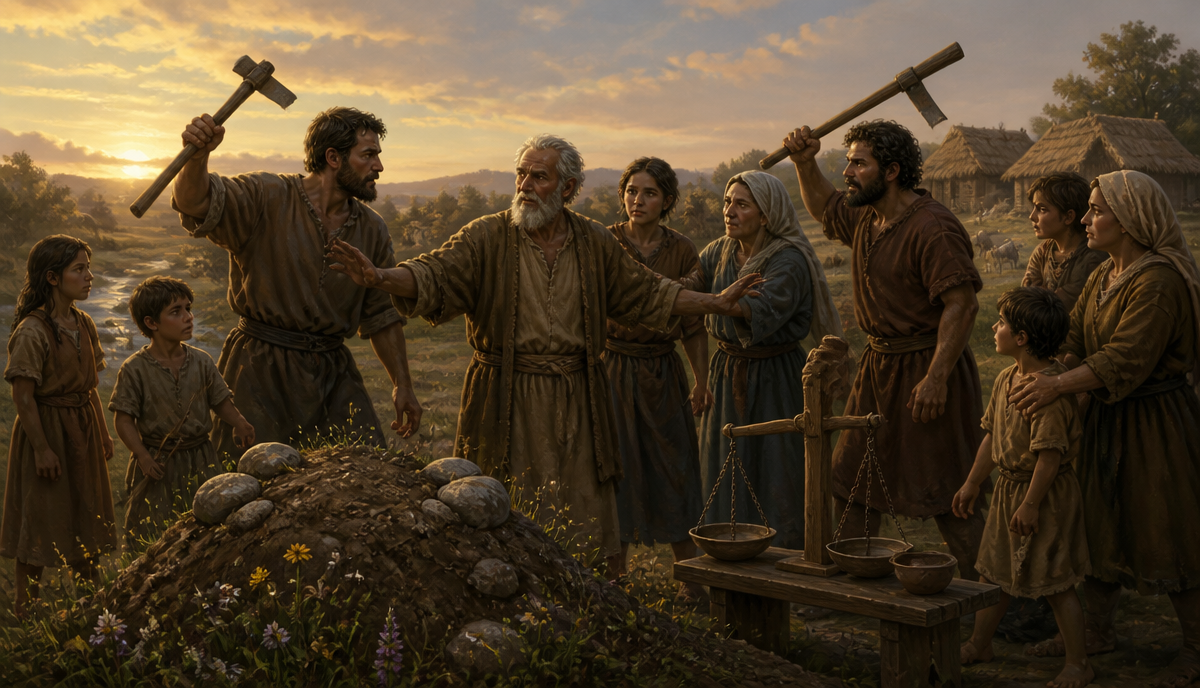
The Two Sons of Adam: The First Family on Earth

The Quran opens this story with a direct command to the Prophet, peace be upon him, to recite to people the account of the two sons of Adam in truth. This is not a tale for entertainment but a report recited in truth so that people may learn from it.
These were the first two sons of the first two parents, in a land that had no cities, no states and no written codes. Even so, the first murder took place there, and it was between two brothers of one father and one mother. That is itself a lesson: corruption does not arise from crowded cities or large populations. It arises in the heart first.
The Quran does not name the two brothers. The names Qabil and Habil became well known among commentators, but they come from the reports of the People of the Book, not from the Quran or an authentic hadith. So the story turns on the deed, not on the name: one had his offering accepted and was killed, the other did not and killed. That is where the lesson lies.
As the commentators mention, the two brothers had different livelihoods, one a man of crops and the other a man of flocks. Both are honourable work, and the difference between them is not in the type of labour but in the piety of the heart.
Lessons
- A Quranic account is recited for its lesson, not for entertainment
- Evil begins in the heart before it shows in the deed
- What the Quran left unnamed carries no ruling worth disputing
Chapter 2
Two Offerings, One Standard

Each of them presented an offering, and it was accepted from one of them and not from the other. The offering looked the same; its fate did not. The Quran mentions neither its size nor its cost, because that is not where the scale is.
When the rejected brother threatened his brother with death, the reply came that is the key to the whole story:
Open surahSurah Al-Ma'idah 5:27
Verified recitation
۞ وَٱتْلُ عَلَيْهِمْ نَبَأَ ٱبْنَىْ ءَادَمَ بِٱلْحَقِّ إِذْ قَرَّبَا قُرْبَانًۭا فَتُقُبِّلَ مِنْ أَحَدِهِمَا وَلَمْ يُتَقَبَّلْ مِنَ ٱلْـَٔاخَرِ قَالَ لَأَقْتُلَنَّكَ ۖ قَالَ إِنَّمَا يَتَقَبَّلُ ٱللَّهُ مِنَ ٱلْمُتَّقِينَ
When they both offered a sacrifice, and it was accepted from one of them and not accepted from the other, he said: I will surely kill you. He said: God only accepts from the God-conscious.
One rule governs every act by which a servant draws near to his Lord, and that rule is piety.
Here the killer's first error appears: instead of asking why his own deed was not accepted, he placed the problem on his brother. The measure is this: when a person sees another granted success in worship, provision or knowledge, he should look inside himself for the cause of his shortfall rather than looking at the other's blessing for a reason to resent.
The Quran explains this elsewhere too: deeds are accepted through sincerity and excellence, not through quantity or appearance. Whoever wants his offering accepted should first correct his heart, then the form of his work.
Lessons
- Piety is the condition of acceptance, not the size of the deed
- One denied success should examine his own heart, not his brother's blessing
- Two deeds can look identical yet differ entirely in worth by intention
Chapter 3
Envy When It Is Left to Grow

The killer did not say: teach me how to be accepted. He said: I will kill you. The distance between envy and crime is very short when envy is not cut off at its beginning.
Envy in essence is an objection to God's distribution: to dislike that another has what God gave him. So the warning came openly:
Open surahSurah An-Nisa 4:32
Verified recitation
وَلَا تَتَمَنَّوْا۟ مَا فَضَّلَ ٱللَّهُ بِهِۦ بَعْضَكُمْ عَلَىٰ بَعْضٍۢ ۚ لِّلرِّجَالِ نَصِيبٌۭ مِّمَّا ٱكْتَسَبُوا۟ ۖ وَلِلنِّسَآءِ نَصِيبٌۭ مِّمَّا ٱكْتَسَبْنَ ۚ وَسْـَٔلُوا۟ ٱللَّهَ مِن فَضْلِهِۦٓ ۗ إِنَّ ٱللَّهَ كَانَ بِكُلِّ شَىْءٍ عَلِيمًۭا
Do not covet what God has favoured some of you with over others.
And God commanded His Prophet to seek refuge from the harm of the envier at the end of Surah Al-Falaq.
Now look at the other brother's stand, one of the greatest in the Quran. He did not threaten and did not prepare for revenge; he said:
Open surahSurah Al-Ma'idah 5:28
Verified recitation
لَئِنۢ بَسَطتَ إِلَىَّ يَدَكَ لِتَقْتُلَنِى مَآ أَنَا۠ بِبَاسِطٍۢ يَدِىَ إِلَيْكَ لِأَقْتُلَكَ ۖ إِنِّىٓ أَخَافُ ٱللَّهَ رَبَّ ٱلْعَٰلَمِينَ
If you extend your hand to kill me, I will not extend mine to kill you. I fear God, Lord of the worlds.
Strength of soul here is not the ability to strike back but the fear of God that holds one back from injustice.
He then said:
Open surahSurah Al-Ma'idah 5:29
Verified recitation
إِنِّىٓ أُرِيدُ أَن تَبُوٓأَ بِإِثْمِى وَإِثْمِكَ فَتَكُونَ مِنْ أَصْحَٰبِ ٱلنَّارِ ۚ وَذَٰلِكَ جَزَٰٓؤُا۟ ٱلظَّٰلِمِينَ
I only want you to bear my sin and your sin
, meaning that if you insist on wrongdoing, the burden is yours, and I will not join you in it by wronging you in turn. This is not surrender to falsehood as a rule, for the Sharia commands repelling injustice and protecting life, but it shows that aggression must not be initiated, nor met with aggression of the same kind.
Lessons
- Envy objects to God's distribution; cut it off at the start
- Real strength is restraint from wrongdoing, not the power to do it
- Never initiate aggression, and never answer it with the same
Chapter 4
And He Became One of the Losers

Then comes the heaviest line:
Open surahSurah Al-Ma'idah 5:30
Verified recitation
فَطَوَّعَتْ لَهُۥ نَفْسُهُۥ قَتْلَ أَخِيهِ فَقَتَلَهُۥ فَأَصْبَحَ مِنَ ٱلْخَٰسِرِينَ
So his soul made the killing of his brother easy for him, and he killed him and became one of the losers.
Note the wording: his soul made it easy for him. He was not forced; his own self smoothed the way until killing became possible for him, then light.
That is how delay works with sin: it starts as a rejected thought, becomes a familiar thought, then becomes a decision. Whoever guards the beginning of that road does not need to escape from its end.
Then came the verdict, a declared loss. In his own eyes he had defeated his brother, yet he lost both his brother and himself. The verses later depict his state: he became one of the regretful, but regret after the moment has passed returns no soul and erases no burden.
For this reason the Sharia is severest of all regarding the sanctity of blood, counting the killing of a soul among the greatest sins after associating partners with God, and tying the protection of life to the protection of the religion as a whole.
Lessons
- Sin begins as a thought and ends as a decision; guard its beginning
- A wrongdoer may think he won while he is the greatest loser
- Regret after the act restores nothing; prevention comes first
Chapter 5
The Lesson of the Raven

Then comes a remarkable scene in how God teaches His servants:
Open surahSurah Al-Ma'idah 5:31
Verified recitation
فَبَعَثَ ٱللَّهُ غُرَابًۭا يَبْحَثُ فِى ٱلْأَرْضِ لِيُرِيَهُۥ كَيْفَ يُوَٰرِى سَوْءَةَ أَخِيهِ ۚ قَالَ يَٰوَيْلَتَىٰٓ أَعَجَزْتُ أَنْ أَكُونَ مِثْلَ هَٰذَا ٱلْغُرَابِ فَأُوَٰرِىَ سَوْءَةَ أَخِى ۖ فَأَصْبَحَ مِنَ ٱلنَّٰدِمِينَ
So God sent a raven scratching in the ground, to show him how to hide the body of his brother. He said: Woe to me, was I unable to be like this raven and hide the body of my brother? So he became one of the regretful.
The killer who saw himself as the stronger stood unable to do the simplest thing owed to a dead body: to bury it. A raven taught him.
In this is a discipline for human pride: the one who wanted to rise above his brother by force had to learn from a bird. It also honours the dead, for the first thing a human being did after the first crime was to learn burial, and from this the honouring of the dead by burying them is as old as humanity itself.
Then grief broke out in his chest as he saw himself less able than a bird to bury his own brother, and he became one of the regretful. The regret here is a late admission that the crime gained him nothing.
Throughout, the narration is strikingly calm: no sensational detail, no description of blood, only the heart, the ruling and the lesson. That is the Quranic method in storytelling: it does not occupy the reader with the scene but with what he must learn.
Lessons
- Pride breaks before the simplest need
- Honouring the dead by burial is among humanity's oldest lessons
- The Quran narrates for instruction, not for sensation
Chapter 6
Whoever Kills One Soul Has Killed All People
The story ends with a universal ruling that belongs to no single family or era:
Open surahSurah Al-Ma'idah 5:32
Verified recitation
مِنْ أَجْلِ ذَٰلِكَ كَتَبْنَا عَلَىٰ بَنِىٓ إِسْرَٰٓءِيلَ أَنَّهُۥ مَن قَتَلَ نَفْسًۢا بِغَيْرِ نَفْسٍ أَوْ فَسَادٍۢ فِى ٱلْأَرْضِ فَكَأَنَّمَا قَتَلَ ٱلنَّاسَ جَمِيعًۭا وَمَنْ أَحْيَاهَا فَكَأَنَّمَآ أَحْيَا ٱلنَّاسَ جَمِيعًۭا ۚ وَلَقَدْ جَآءَتْهُمْ رُسُلُنَا بِٱلْبَيِّنَٰتِ ثُمَّ إِنَّ كَثِيرًۭا مِّنْهُم بَعْدَ ذَٰلِكَ فِى ٱلْأَرْضِ لَمُسْرِفُونَ
Because of that, We decreed upon the Children of Israel that whoever kills a soul, other than for a soul or for corruption in the land, it is as if he had killed all people, and whoever saves one, it is as if he had saved all people.
This is the greatest principle for the protection of life ever revealed in a book: the worth of one human being equals the worth of all people. Whoever permits one killing has permitted the principle itself, and whoever saves a soul has saved humanity within himself.
The practical lessons of the story reach into every home:
- Treat envy by praying for the one envied and by looking at God's blessings on you.
- Correct the heart before the form of the deed, since piety is the condition of acceptance.
- Restrain hand and tongue from wrongdoing even when you have the power to act.
- End a dispute among relatives at its start, before it becomes enmity.
The platform offers what strengthens this side: the azkar to protect the heart from envy and rancour, the full Surah Al-Maidah where these verses appear, recitations to listen to, and other stories such as Harut and Marut on the subject of trials.
Questions people often ask
Where is the story in the Quran?
In Surah Al-Maidah: "And recite to them the story of the two sons of Adam in truth." The Quran does not name them; the names come from later commentary.
Who said "I will surely kill you"?
The brother whose offering was not accepted, speaking out of envy. His brother answered that God accepts only from the God-conscious, returning the matter to piety rather than persons.
What is the central lesson?
Envy left untreated at its start ends in the gravest of crimes, which is why the passage closes with the sanctity of a single life standing for all of humanity.
Lessons
- One soul carries the worth of all people
- Treat envy with supplication and gratitude
- End a dispute at its start before it becomes enmity
Interactive quiz
Answer the questions below, then check your answers. No account needed.
1. In which surah is the story of Adam's two sons told?
2. What condition for acceptance does the verse state?
3. How did the brother answer when threatened with death?
4. How does the Quran describe the killer after the crime?
5. What did the raven teach the killer?
6. What universal principle closes the story?
The illustrations are our own, free of copyright restrictions, and do not depict identified religious figures.
Related stories
Data sources
- The Quran: Surah Al-Maidah 27-32
- Tafsir al-Tabari, Jami al-Bayan
- Tafsir Ibn Kathir
- Tafsir al-Sadi, Taysir al-Karim al-Rahman
- Sahih al-Bukhari and Muslim: reports on the sanctity of blood and the prohibition of envy