Stories
Prophet Adam and Iblis
The Quranic account of the first human being: the announcement of stewardship on earth and the angels question, the shaping of Adam from clay and the breathing of the spirit, the knowledge of the names and the prostration of the angels, the proud refusal of Iblis and the reprieve he requested, life in the Garden with one forbidden tree, then the whispering, the slip and the repentance, and finally the descent to earth and the beginning of an enmity that never rests.

Recitation audio comes from verified reciters. AI-generated voice is never used for Quran recitation.
Chapter 1
Before Adam Was Created

The story begins before the human being existed at all. The creation of Adam, peace be upon him, was not an accident along the way of the universe but a decision announced before he came to be: that this earth would have a steward, a bearer of responsibility and cultivation and duty, not merely someone who lives and eats.
The Quran preserved that first scene with its full dialogue:
Open surahSurah Al-Baqarah 2:30
Verified recitation
And when your Lord said to the angels, "Indeed, I will make upon the earth a successive authority." They said, "Will You place upon it one who causes corruption therein and sheds blood, while we declare Your praise and sanctify You?" Allah said, "Indeed, I know that which you do not know."
And when your Lord said to the angels, "Indeed, I will make upon the earth a successive authority." They said, "Will You place upon it one who causes corruption therein and sheds blood, while we declare Your praise and sanctify You?" Allah said, "Indeed, I know that which you do not know."
The angels question is not an objection nor an accusation, but a request for understanding from beings who never disobey a command. They saw that this new creature carried the capacity for corruption and bloodshed, so they asked about the wisdom. The answer came in a single phrase that summarises everything to follow: a knowledge that belongs to God alone.
Here the whole story begins to make sense. The human being was not placed on earth to be incapable of sin, but to be capable of choice. Choice means corruption is possible and righteousness is possible, and that the worth of obedience appears only when disobedience was available. Praise offered with no alternative is perfect in its own place, but it is not the test God intended for this creature.
Within the word steward itself lies a heavy dignity: the earth is a trust in your hands, and a person is asked about what he did with it, not only about what he wished for. To see the scene fully in its context, begin from the source: read Surah Al-Baqarah in full.
Lessons
- Stewardship on earth is a duty and a responsibility, not mere privilege
- Asking in order to understand is not objecting to wisdom
- Obedience gains its worth when disobedience was possible
Chapter 2
From Clay, Then the Breath of the Spirit

Then came the creation. It was not a sudden act without stages, but a fashioning whose stages the Quran describes: dust, then clay, then dried clay like pottery, then altered black mud. The substance came from the very earth this creature would inhabit, so that he would never forget his origin whenever he looked down at his feet.
God said:
Open surahSurah Al-Hijr 15:28
Verified recitation
And when your Lord said to the angels, "I will create a human being out of clay from an altered black mud."
And when your Lord said to the angels, "I will create a human being out of clay from an altered black mud."
The material is humble, yet the honour never lay in the material. The honour came in the second stage:
Open surahSurah Al-Hijr 15:29
Verified recitation
And when I have proportioned him and breathed into him of My [created] soul, then fall down to him in prostration."
And when I have proportioned him and breathed into him of My [created] soul, then fall down to him in prostration."
Here the entire definition of the human being takes shape: a body of clay and a spirit from the command of God. This double nature explains every struggle a person lives. Within him is what pulls him toward the earth, appetite and need and weakness, and within him is what lifts him toward the sky, knowledge and shame and a longing for meaning larger than food and drink.
That is why the human soul is never understood by anyone who looks at it from one side only. Whoever saw it as clay alone neglected it, and whoever imagined it pure spirit burdened it beyond its capacity. The Quran gathers both sides in a single verse: a body proportioned, then a breath that makes this body a place of accountability.
The prostration commanded was not worship of Adam but honour for him and obedience to God. It is a fine distinction, missed by anyone who wanted to turn honour into worship. Whoever wishes to recall his origin and his end each day may keep a portion of the daily remembrances.
Lessons
- Human honour lies in the breath of the spirit, not in the material
- The double nature explains the soul struggle between clay and spirit
- Honour by God command is not worship of the one honoured
Chapter 3
The Names, All of Them

The first thing that distinguished this creature was not strength of body nor speed of movement, but knowledge. It was not partial knowledge either, but the capacity to name things and grasp their realities, which is the root of every civilisation later built on earth.
God said:
Open surahSurah Al-Baqarah 2:31
Verified recitation
And He taught Adam the names - all of them. Then He showed them to the angels and said, "Inform Me of the names of these, if you are truthful."
And He taught Adam the names - all of them. Then He showed them to the angels and said, "Inform Me of the names of these, if you are truthful."
The answer came at the highest level of courtesy before God, a courtesy the honest scholar knows and the pretender never learns:
Open surahSurah Al-Baqarah 2:32
Verified recitation
They said, "Exalted are You; we have no knowledge except what You have taught us. Indeed, it is You who is the Knowing, the Wise."
They said, "Exalted are You; we have no knowledge except what You have taught us. Indeed, it is You who is the Knowing, the Wise."
Then came the practical demonstration rather than theoretical argument:
Open surahSurah Al-Baqarah 2:33
Verified recitation
He said, "O Adam, inform them of their names." And when he had informed them of their names, He said, "Did I not tell you that I know the unseen aspects of the heavens and the earth? And I know what you reveal and what you have concealed."
He said, "O Adam, inform them of their names." And when he had informed them of their names, He said, "Did I not tell you that I know the unseen aspects of the heavens and the earth? And I know what you reveal and what you have concealed."
This scene answers the angels first question. Fitness for stewardship never lay in being incapable of sin, but in the capacity to learn and to teach, to build and to correct and to repent. A creature who errs and then learns may reach what one who neither errs nor learns will never reach.
The command to inform was not meant to embarrass the angels but to unveil a wisdom that had not been visible. So it is with much of what God decrees in our lives: the surface looks strange, then the wisdom appears in a later scene. Whoever wishes to taste something of this knowledge may read and search the revealed text itself through Quran search.
Lessons
- Knowledge was the first honour given to the human being
- Saying we know only what You taught us is the courtesy of an honest scholar
- Fitness for stewardship lies in learning and correcting, not in being sinless
Chapter 4
Iblis Refuses
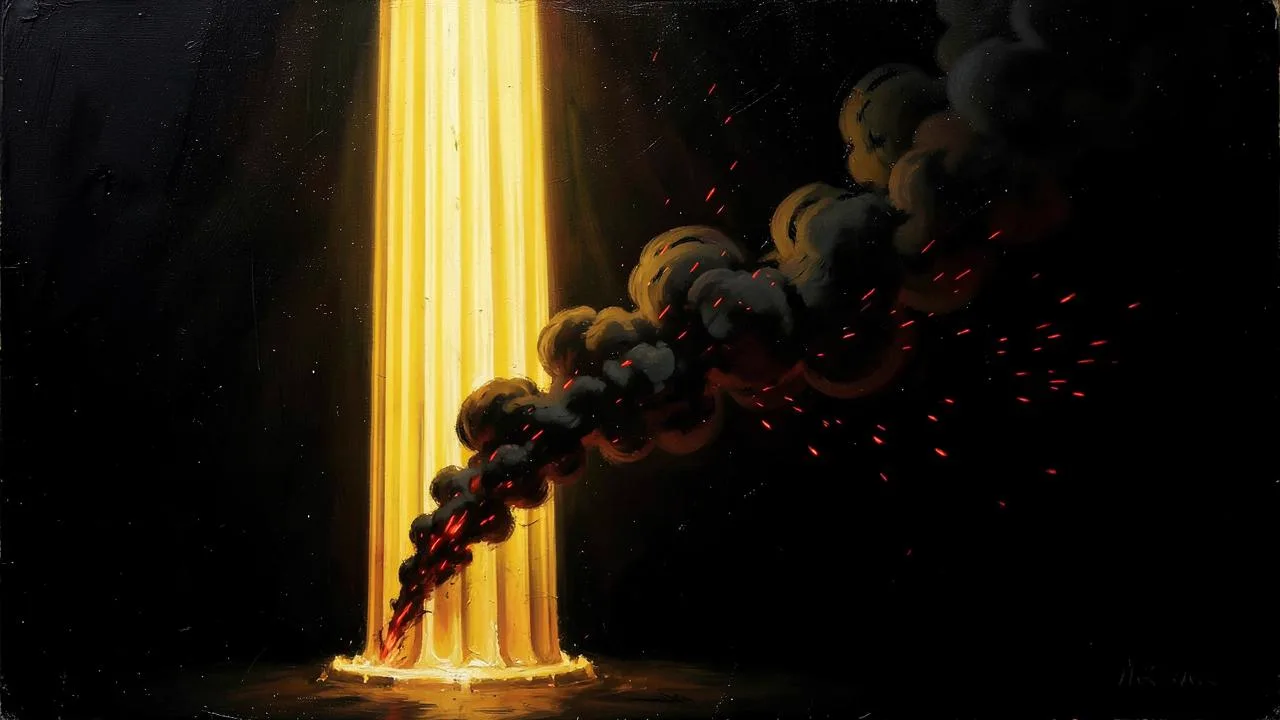
All the angels prostrated together, except one. His refusal was not ignorance of the command nor doubt about its source, but a conscious rejection, because he saw himself as too great to comply. That is arrogance: to know the truth and refuse to bow to it.
God asked him why he refused, and the answer exposed the disease of his heart:
Open surahSurah Al-A'raf 7:12
Verified recitation
Allah said, "What prevented you from prostrating when I commanded you?" Satan said, "I am better than him. You created me from fire and created him from clay."
Allah said, "What prevented you from prostrating when I commanded you?" Satan said, "I am better than him. You created me from fire and created him from clay."
He measured substance against substance, missing that the matter was never a comparison of fire and clay but a test of obedience. Whoever busies himself comparing his own standing with people forgets what he himself was commanded to do.
So the sentence matched the crime exactly:
Open surahSurah Al-A'raf 7:13
Verified recitation
Allah said, "Descend from Paradise, for it is not for you to be arrogant therein. So get out; indeed, you are of the debased."
Allah said, "Descend from Paradise, for it is not for you to be arrogant therein. So get out; indeed, you are of the debased."
The one who sought height through pride was sent out belittled.
Then he revealed his whole intention in a plain request:
Open surahSurah Al-Hijr 15:36
Verified recitation
He said, "My Lord, then reprieve me until the Day they are resurrected."
He said, "My Lord, then reprieve me until the Day they are resurrected."
He was granted a fixed term:
Open surahSurah Al-Hijr 15:37
Verified recitation
Allah said, "So indeed, you are of those reprieved
Allah said, "So indeed, you are of those reprieved
Open surahSurah Al-Hijr 15:38
Verified recitation
until the Day of the time well-known."
until the Day of the time well-known."
At that point he announced his plan without disguise:
Open surahSurah Al-Hijr 15:39
Verified recitation
Iblees said, "My Lord, because You have put me in error, I will surely make disobedience attractive to them on earth, and I will mislead them all
Iblees said, "My Lord, because You have put me in error, I will surely make disobedience attractive to them on earth, and I will mislead them all
Notice the key word in his plan: he will make it attractive. He holds no power to compel and no authority to force, only the ability to beautify the ugly until it looks acceptable. This remains his most dangerous instrument today: he does not tell people to disobey, he tells them that this is not disobedience.
Lessons
- Arrogance is knowing the truth and refusing to submit to it
- Comparing yourself with others makes you forget your own command
- Satan weapon is beautification, never compulsion
Chapter 5
The Garden and the Tree
Adam and his wife were settled in the Garden, and everything was permitted to them except one thing. The proportion deserves reflection: a vast permission and a single prohibition. Yet the single prohibition would become the site of the whispering, because Satan does not work on what is allowed but on what is withheld.
God said:
Open surahSurah Al-Baqarah 2:35
Verified recitation
And We said, "O Adam, dwell, you and your wife, in Paradise and eat therefrom in ease and abundance from wherever you will. But do not approach this tree, lest you be among the wrongdoers."
And We said, "O Adam, dwell, you and your wife, in Paradise and eat therefrom in ease and abundance from wherever you will. But do not approach this tree, lest you be among the wrongdoers."
Then the whispering came, not as a command to disobey but as advice offering a tempting gain:
Open surahSurah Al-A'raf 7:20
Verified recitation
But Satan whispered to them to make apparent to them that which was concealed from them of their private parts. He said, "Your Lord did not forbid you this tree except that you become angels or become of the immortal."
But Satan whispered to them to make apparent to them that which was concealed from them of their private parts. He said, "Your Lord did not forbid you this tree except that you become angels or become of the immortal."
He turned the prohibition from mercy into deprivation, and made them imagine that behind the tree lay sovereignty and everlasting life. Then he sealed it with the most dangerous thing that can be said, a false oath:
Open surahSurah Al-A'raf 7:21
Verified recitation
And he swore to them, "Indeed, I am to you from among the sincere advisors."
And he swore to them, "Indeed, I am to you from among the sincere advisors."
Here his method appears fully in three steps: cast doubt on the wisdom of the prohibition, offer an imagined gain, then swear that he is a sincere advisor. It is the same method that convinces people today that forbidden earnings are provision, that neglecting prayer is a demand of work, and that backbiting is merely describing reality.
The lesson is intensely practical: whoever wishes to protect himself guards the boundary rather than walking up to it to test his own strength. The words were do not approach, not merely do not eat. Protecting the heart begins with distance, not with confrontation. Whoever wishes to order his day around steady worship may begin with prayer times.
Lessons
- Whispering begins by casting doubt on the wisdom of a prohibition
- A false oath is the most dangerous tool of temptation
- Guard limits by keeping distance, not by testing them
Chapter 6
The Slip and the Repentance

Then what happened, happened. They ate from the tree, what had been covered was exposed to them, and the sweet promise that had lured them evaporated. This is the nature of every act of disobedience: it is beautified before the deed and reveals a loss, not a profit, after it.
Yet the decisive moment of the story is not the slip but what came after it. Adam did not flee from responsibility, did not look for an excuse, and did not claim that Satan had forced him. He returned and attributed the wrong to himself:
Open surahSurah Al-A'raf 7:23
Verified recitation
They said, "Our Lord, we have wronged ourselves, and if You do not forgive us and have mercy upon us, we will surely be among the losers."
They said, "Our Lord, we have wronged ourselves, and if You do not forgive us and have mercy upon us, we will surely be among the losers."
Divine grace met him with something better than he could expect:
Open surahSurah Al-Baqarah 2:37
Verified recitation
Then Adam received from his Lord some words, and He accepted his repentance. Indeed, it is He who is the Accepting of repentance, the Merciful.
Then Adam received from his Lord some words, and He accepted his repentance. Indeed, it is He who is the Accepting of repentance, the Merciful.
Reflect on the verb: he received. The words themselves were a gift from God before they were an effort from the servant. Even repentance is an enabling that is granted; the servant stretches out his hand and finds the path already prepared before he searched for it.
Here appears the essential difference between Adam and Iblis, the difference on which the whole story turns. Both broke a command, but one confessed and was raised, and the other was proud and argued and fell. The problem is not merely that a mistake occurred, but insisting on it and justifying it.
So the first human being was also the first to repent, that repentance might stand as an open door from the very beginning of human history. Whoever wishes to make seeking forgiveness a daily habit will find help in the remembrances and the tasbih counter.
Lessons
- Admitting the mistake is the first step of return
- Repentance is enabled by God before it is an effort of the servant
- The difference between Adam and Iblis is confession versus justification
Chapter 7
The Descent and a Lasting Enmity

Then came the descent to earth. It was not exile nor revenge, but a move to the place announced from the beginning: stewardship on earth, a temporary residence, and provision for a time.
God said:
Open surahSurah Al-Baqarah 2:36
Verified recitation
But Satan caused them to slip out of it and removed them from that condition in which they had been. And We said, "Go down, all of you, as enemies to one another, and you will have upon the earth a place of settlement and provision for a time."
But Satan caused them to slip out of it and removed them from that condition in which they had been. And We said, "Go down, all of you, as enemies to one another, and you will have upon the earth a place of settlement and provision for a time."
The human being was not left on this earth without guidance, so the promise on which all prophethood rests was given:
Open surahSurah Al-Baqarah 2:38
Verified recitation
We said, "Go down from it, all of you. And when guidance comes to you from Me, whoever follows My guidance - there will be no fear concerning them, nor will they grieve."
We said, "Go down from it, all of you. And when guidance comes to you from Me, whoever follows My guidance - there will be no fear concerning them, nor will they grieve."
The earth is a place of testing, not of recompense, and in it there is guidance to follow and a devil to guard against. Hence the instruction came plainly, needing no interpretation:
Open surahSurah Fatir 35:6
Verified recitation
Indeed, Satan is an enemy to you; so take him as an enemy. He only invites his party to be among the companions of the Blaze.
Indeed, Satan is an enemy to you; so take him as an enemy. He only invites his party to be among the companions of the Blaze.
This story is not a tale about a past that ended, but a description of what happens every day inside every human being. In it there is a command that is known, a whispering that beautifies, a boundary that is approached, a slip that occurs, and a door of repentance that never closes.
The difference between the one who succeeds and the one who loses is not whether a mistake happened, for that is shared by all the children of Adam, but the direction taken afterwards: a return like the return of Adam, or an insistence like the insistence of Iblis. So mercy is wider than the slip, guidance is nearer than the whispering, and the door stands open for whoever wants to enter.
If you wish to follow the accounts of the prophets who came after him, begin from the prophet stories library.
Lessons
- The earth is a place of testing, not of recompense
- Guidance is a divine promise; no one is left without it
- What matters is not that a mistake occurred but the direction taken after it
Interactive quiz
Answer the questions below, then check your answers. No account needed.
1. What did God announce to the angels before creating Adam?
2. What gave Adam his honour rather than the material he was made from?
3. How did the angels answer when asked about the names?
4. What argument did Iblis give for refusing to prostrate?
5. What illusion did Satan present at the tree?
6. What is the essential difference between Adam and Iblis after disobeying?
7. What plain Quranic instruction is given about Satan after the descent?
Illustrations are our own, free of copyright restrictions, and are not depictions of the prophets themselves.
Data sources
- Surah Al-Baqarah 2:30-39
- Surah Al-Araf 7:11-25
- Surah Al-Hijr 15:26-42
- Surah Fatir 35:6
- Tafsir Ibn Kathir
- Tafsir al-Tabari