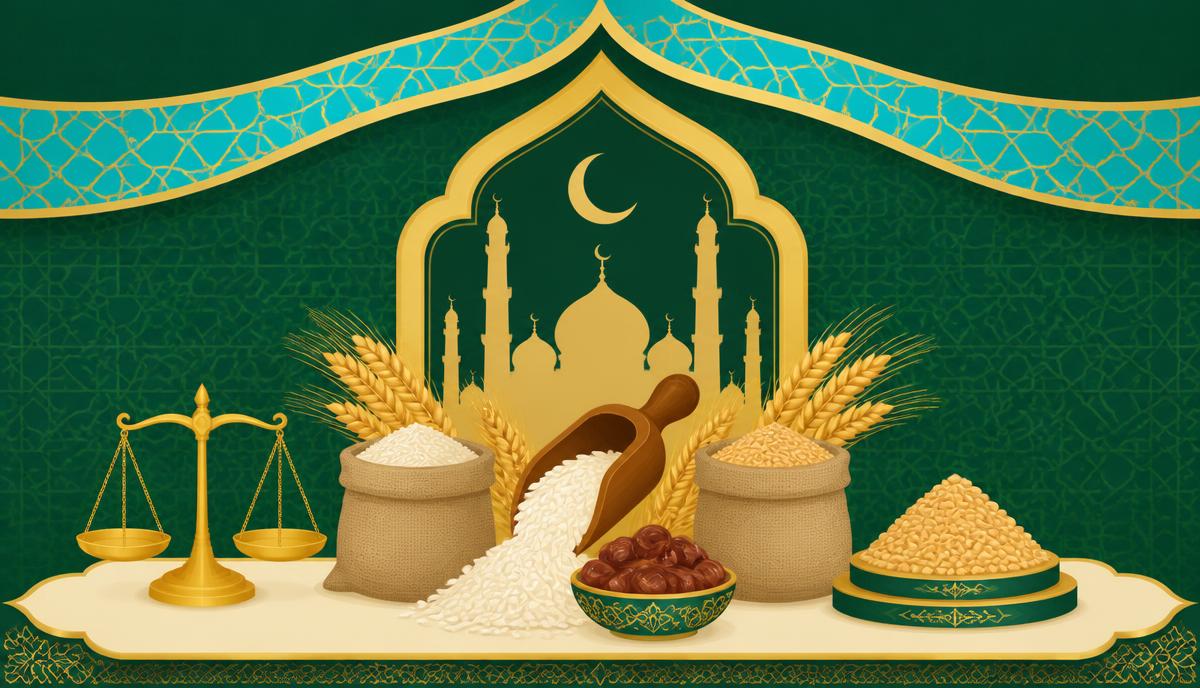
At the end of Ramadan the same question returns: how many kilograms is zakat al-Fitr? You will find several answers: 2.5 kg, 2.75 kg, 3 kg. They are not as contradictory as they look, and the reason fits in one sentence: the sa measures volume, not weight.
What the sa is, and why its weight changes
The sa was a well known measure in Madinah in the Prophet's time, equal to four mudd, estimated by contemporary scholars at roughly 2.75 to 3 litres. Fill a fixed volume with staples of different densities and the weight must differ: a sa of rice weighs more than a sa of barley, and dates vary with type and moisture.
So there is no single correct kilogram figure for every staple. There is one per staple:
| Staple | Estimated weight per sa | Note |
|---|---|---|
| Rice | about 2.5 kg | The most commonly paid staple today in many countries |
| Wheat | about 2.6 to 2.8 kg | The grain named in many of the reports |
| Barley | about 2.2 to 2.4 kg | Lighter than wheat, lower density |
| Dates | about 2 to 2.5 kg | Varies with variety and moisture |
| Raisins | about 2 to 2.3 kg | Named explicitly in the hadith |
These are the estimates in common use in contemporary fatwas. When paying in food, err slightly above rather than below. To work out a whole household at once, the zakat al-Fitr calculator gives both total weight and an estimated cash value.
Why it was legislated as food
Ibn Umar reported that the Prophet made zakat al-Fitr obligatory as one sa of dates or one sa of barley upon every Muslim, free or bonded, male or female, young or old. Ibn Abbas reported that it purifies the fasting person and feeds the poor.
There are therefore two aims: purifying the fasting person, and feeding the poor on the day of Eid so that the search for food does not spoil their celebration. This is the root of the debate about paying cash.
Paying cash: the two positions
- Those who do not permit it, the well known Shafii, Maliki and Hanbali position: the text specifies food, acts of worship follow their prescribed form, and food reaches the poor directly.
- Those who permit it, the Hanafi position and a view held by others: the aim is to enrich the poor on Eid, and cash serves them better today because they buy what they actually need. Similar reports are attributed to Umar ibn Abd al-Aziz and al-Hasan al-Basri.
In practice, many fatwa authorities and charities announce an annual cash value for the sa to make it easier, then buy and deliver the food on the payer's behalf. Your country's announcement is your reference, because staple prices differ by country and by year.
Estimating the cash value yourself
The rule is simple: the weight of a sa of your staple x the local price per kilogram.
Example: a household of six paying rice, at 2.5 kg per sa, with rice at 1.20 dinars per kilogram:
- Total weight = 6 x 2.5 = 15 kg
- Value = 15 x 1.20 = 18 dinars
Do not copy another country's figure or last year's figure. Staple food prices moved noticeably across most Arab markets between 2023 and 2026, and the amount follows the price, not custom.
When to pay
- Best before the Eid prayer, per Ibn Abbas: whoever pays it before the prayer, it is an accepted zakat; whoever pays after the prayer, it is an ordinary charity.
- Permitted a day or two early; the Shafiis allowed it from the start of Ramadan and the Hanafis were broader still.
- If delayed past the Eid prayer without excuse, it remains a debt to be paid; it does not lapse.
The start of Shawwal for your city is on the Hijri calendar and the Ramadan page.
Who you pay for
| Person | Ruling |
|---|---|
| Yourself | Due |
| Your wife | Due; many jurists have the husband pay for her, or she pays for herself |
| Young children | Due from whoever supports them |
| An adult child with his own income | Pays for himself |
| An unborn child | Not due; some scholars consider it commendable, following Uthman |
| A hired worker | Pays for himself, since the wage is his |
| Someone who died before sunset on the last day of Ramadan | Not due |
Frequently asked questions
Is it due from a poor person?
It is due from anyone who has their day's food and one sa to spare, even if of modest means. Someone with nothing beyond essential need owes nothing.
Can one sa be split among several poor people, or several sa given to one?
Both are permitted in the majority view; what matters is that the amount reaches those entitled to it.
Can cooked food or ready meals be given?
The basis is storable staples the poor can use whenever they choose. For those who require food rather than cash, cooked meals do not discharge the obligation, because they remove the recipient's ownership and choice.
Can it be sent to a charity abroad?
It is preferable to spend it on the poor of the payer's own locality, since the aim is to relieve them on Eid day. Some scholars permitted transferring it for a stronger need, such as far greater poverty elsewhere.
How does it differ from zakat on wealth?
Zakat al-Fitr is a fixed amount per person tied to Eid. Zakat on wealth is 2.5% of wealth that reached the threshold and completed a lunar year. The calculations are entirely different, and each has its own tool: zakat al-Fitr and zakat on money.
One practical step
Choose your staple, take its sa weight from the table above, multiply by the number of people you support, and if you are paying cash multiply by today's local price per kilogram. Hand it over before the Eid prayer. If your country publishes an official value, follow it: it is closer to your market than any general estimate.
Related articles



Data sources
- Sahih al-Bukhari and Sahih Muslim, the report of Ibn Umar on zakat al-Fitr
- Sunan Abu Dawud, the report of Ibn Abbas on purification and feeding the poor
- Kuwaiti Encyclopedia of Islamic Jurisprudence, entry on zakat al-Fitr
- Annual cash values announced by national fatwa authorities and charities
- International Islamic Fiqh Academy
- Permanent Committee for Scholarly Research and Ifta
- Sunnah.com
- IslamWeb
- Al-Azhar University
Last updated: 17 October 2026