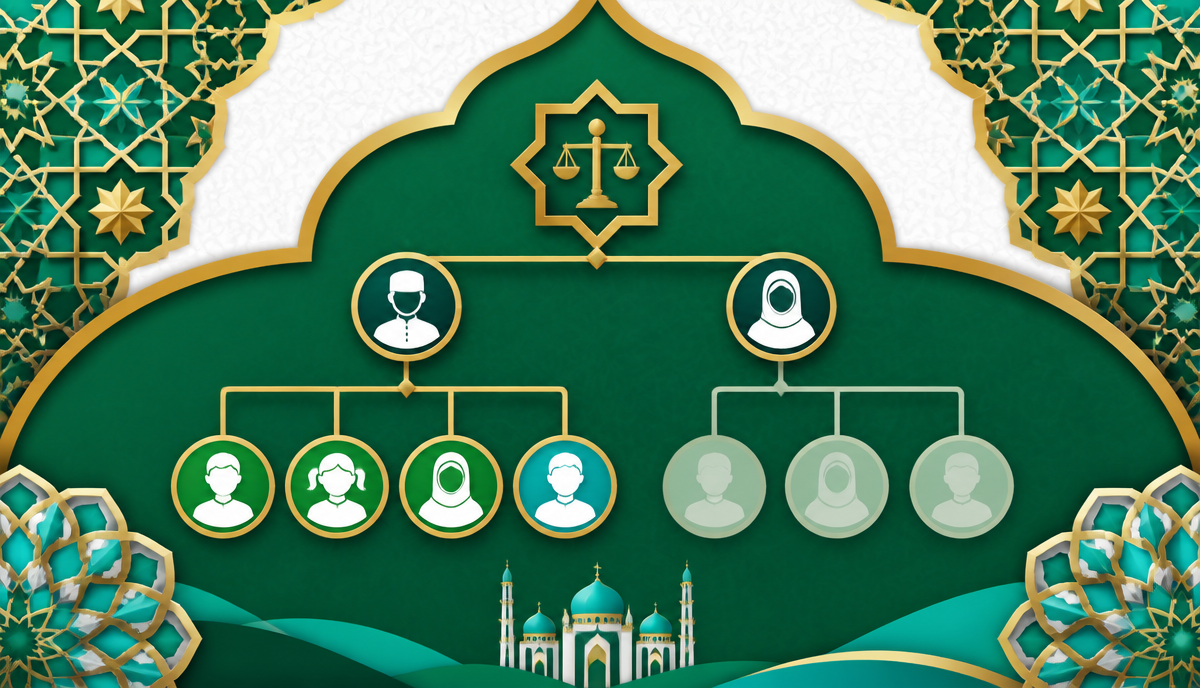
One reason inheritance is confusing is that the presence of one heir can remove another. This is called exclusion by person: the closer relative excludes the more distant one through the same ground of inheritance.
The basic rule
The closer heir in the same line excludes the more distant one.
"Same line" means both inherit through the same ground: both are descendants, or both are ascendants, or both are collaterals. If the ground differs, there is no exclusion: the wife and father both inherit, because the wife inherits through marriage and the father through kinship.
Common exclusion cases
| Closer heir | Excluded heir | Reason |
|---|---|---|
| Son | Son's son | closer male descendant |
| Father | Grandfather | closer male ascendant |
| Full brother | Half-brother by father | closer male collateral |
| Son | Full brother | descendant excludes collateral |
| Father | Siblings | ascendant excludes collateral |
| Daughter | Son's daughter | closer female descendant |
Is the grandmother excluded?
The maternal grandmother is not excluded by the mother; she inherits the one-sixth with her if the mother is absent. The paternal grandmother may be excluded by the father or grandfather depending on the school.
Those who do not inherit for other reasons
Some people do not inherit for reasons other than a closer heir:
- A divorced wife after the waiting period: the marriage ground is cut.
- Someone of a different religion: difference in religion prevents inheritance in the majority view.
- An intentional killer: excluded as retribution.
- Distant relatives by womb: such as the paternal aunt or son's daughter, who do not inherit by fixed share or residuary right in the well-known view.
Worked example
Estate of 300,000 dinars, heirs: father, mother, wife, son, daughter.
- Mother: one-sixth = 50,000
- Wife: one-eighth = 37,500 (because there is a descendant heir)
- Father: one-sixth fixed = 50,000, then takes the remainder by residuary right
- Remainder = 300,000 - 50,000 - 37,500 = 212,500 to the father residually
- Son and daughter: inherit nothing because the father excludes them
Notice how the father alone changes all the shares.
Link to the obligatory bequest
In some Arab countries, such as Egypt and Syria, the children of a predeceased son receive an obligatory bequest up to one-third despite being excluded by the living son. This is a legal exception, so check your country's personal status code.
Practical summary
- Start with the closest relatives: children, then parents, then siblings.
- If a closer heir exists, remove the more distant one of the same ground.
- Give fixed-share heirs their portions first, then distribute the remainder to residuary heirs.
- Test the case in the inheritance calculator to verify.
- For more on fixed shares and worked cases, see our article Who Inherits and Who Does Not.
Data sources
Last updated: 7 September 2026