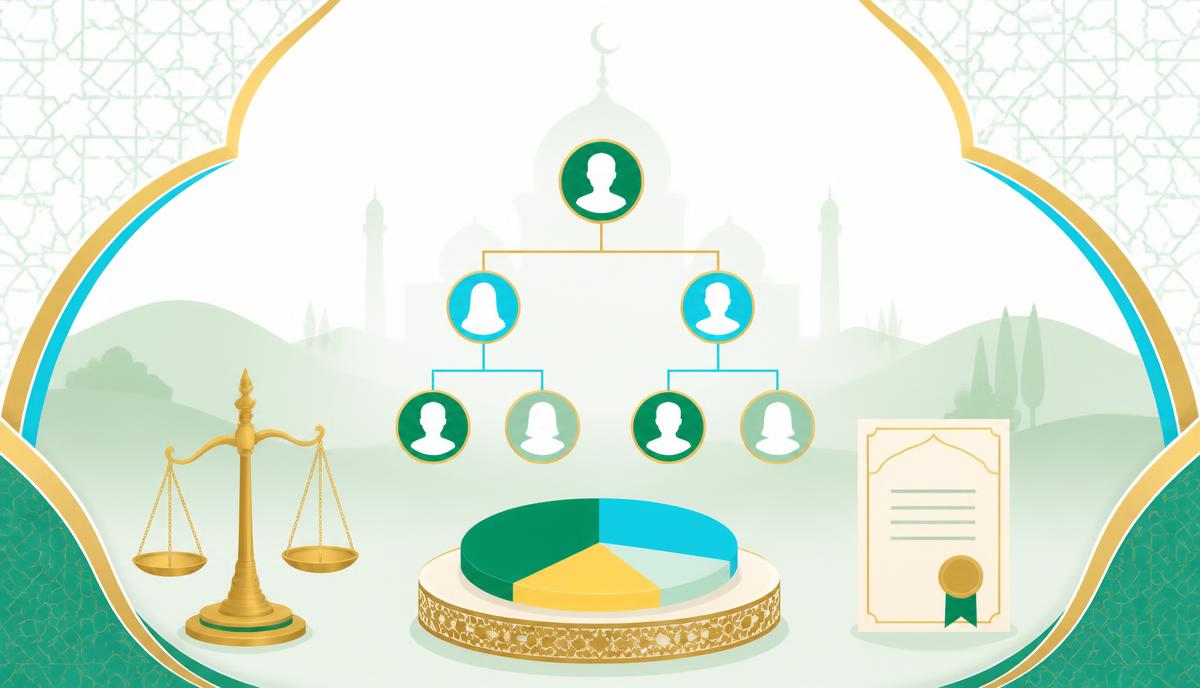
Inheritance is the most arithmetic-heavy chapter of Islamic law, and the most likely to cause family disputes. Much of the confusion is linguistic: the classical books are written in technical terms such as fixed share, residuary heir, exclusion, deficit and correction. This guide explains each idea before naming it, then works through five complete cases so you can see the rules operate.
Only three grounds for inheriting
No one inherits except through one of three:
- Kinship: ascendants such as father, mother and grandfather; descendants such as son, daughter and son's son; and collaterals such as siblings and paternal uncles.
- Marriage: a valid marriage in force at the time of death.
- Manumission: a historical category with no application today.
Friendship, upbringing, neighbourliness and closeness create no inheritance right. To give to a non-heir, the routes are a bequest within one third of the estate, or a gift during life.
Heirs with fixed shares
A fixed share is an amount set by text: one half, one quarter, one eighth, two thirds, one third, one sixth. Twelve people can hold them: four men and eight women.
| Heir | Share | Condition |
|---|---|---|
| Husband | One half | No surviving descendant |
| Husband | One quarter | A surviving descendant exists |
| Wife | One quarter | No surviving descendant |
| Wife | One eighth | A descendant exists; co-wives divide it |
| Daughter | One half | Sole daughter with no son |
| Two or more daughters | Two thirds | No son among them |
| Mother | One sixth | A descendant, or a group of siblings, exists |
| Mother | One third | No descendant and no group of siblings |
| Father | One sixth | A male descendant exists |
| Full sister | One half | Sole sister, no descendant and no father |
| Two full sisters | Two thirds | Same condition |
| Maternal half sibling | One sixth alone, one third as a group | No descendant, father or grandfather |
Whatever remains after the fixed shares goes to the residuary heirs: the son, then son's son, then father, then full brother, then paternal half brother, then their sons, then the paternal uncle and his sons. Their rule: the nearer excludes the more distant.
Who does not inherit, and why
- Excluded by someone nearer: a brother does not inherit alongside a son, a grandson does not inherit alongside a son, and a grandfather is excluded by the father.
- No qualifying ground: a divorced woman after the waiting period ends, or someone with no established lineage.
- Recognised bars: difference of religion, and the bar on someone who intentionally killed the deceased.
- Grandmothers, paternal aunts and nieces and other distant relatives take neither a fixed share nor a residue in the well known view; some scholars give them the estate only when no other heir exists.
One point often missed: distribution begins after burial costs, then debts, then any bequest within one third to a non-heir. What remains is the distributable estate.
Five worked cases
A wife and two sons
- Wife: one eighth = 12.5%
- The remaining 87.5% goes to the two sons equally, so 43.75% each
On an estate of 240,000 units: wife 30,000, each son 105,000.
Father, mother and one daughter
- Daughter: one half = 50%
- Mother: one sixth = 16.67%
- Father: one sixth as a fixed share, then the remainder as residue, so 33.33% in total
On 120,000: daughter 60,000, mother 20,000, father 40,000.
A husband and a full sister
- Husband: one half = 50%
- Full sister: one half = 50%
There is no descendant and no father, so the two shares are equal. On 80,000: 40,000 each.
Mother and full siblings (a brother and two sisters)
- Mother: one sixth, because a group of siblings reduces her from a third = 16.67%
- The remaining 83.33% goes to the siblings as residue, the male taking twice the female share: four parts, two for the brother and one for each sister
On 60,000: mother 10,000, brother 25,000, each sister 12,500.
Two daughters and a full brother
- Daughters: two thirds = 66.67%, shared equally
- Full brother: the remaining 33.33% as residue
On 90,000: each daughter 30,000, brother 30,000. Note that the brother inherits here only because there is no male descendant to exclude him.
The common denominator and the deficit case
Adding fractions needs a common denominator, called the basis of the case. With a half and a sixth the denominator is 6; with an eighth and a half it is 8.
Sometimes the shares add to more than the basis. The case is then said to be in deficit, and everyone is reduced proportionally. The classic example is a husband with two full sisters.
- Husband: one half = 3 of 6
- Sisters: two thirds = 4 of 6
- Total 7 of 6, so the basis is raised to 7
The husband takes 3 of 7, which is 42.86%, and each sister 2 of 7, which is 28.57%. Nobody is wronged; everyone is reduced by the same proportion because the prescribed shares exceeded the estate. When the parts do not divide among the heirs without fractions, the basis is multiplied by the number of heads, which is called correction.
Frequently asked questions
Why do male and female shares differ in some cases?
Because the system pairs entitlement with obligation: maintaining a wife and children and paying the dower are legal duties on the man, while a woman's share is hers outright with no maintenance claim against it. The pattern is not universal either: mother and father both take a sixth when a descendant survives, and maternal half siblings take equal shares regardless of sex.
Does a grandchild inherit if his father died before the grandfather?
Not alongside a surviving son of the deceased, in the well known view, because the nearer excludes the more distant. Several national codes in the Muslim world address this through an obligatory bequest for the children of a predeceased son, applied in Egypt, Syria and elsewhere, so check your own family law.
Can a bequest change the heirs' shares?
A bequest to an heir is valid only if the other heirs consent, and no bequest to a non-heir may exceed one third of the estate. Anything beyond that depends on the heirs' agreement.
Where are the deceased's debts paid from?
From the estate before any distribution and before any bequest is carried out. What is divided is the net estate.
Does the calculator replace a court?
No. The inheritance calculator is an educational tool that gives a sound picture in ordinary cases, and the common cases page shows more worked examples. A binding division comes from the competent court or a qualified jurist after reviewing the death certificate, proof of lineage, debts, bequests and your country's law.
Practical summary
- Deduct burial costs, debts, and any bequest within one third.
- List the surviving heirs precisely; one extra person changes every proportion.
- Give the fixed shares first, then the residue to the residuary heirs.
- Run the case through the inheritance calculator to check your figures.
- Register the division officially; documentation is what prevents disputes years later.
This article and the calculator are for explanation and learning, not for settling an active dispute or for reliance in an official procedure.
Related articles

Data sources
- The Quran, Surah an-Nisa: inheritance verses 11, 12 and 176
- Sahih al-Bukhari, Book of Inheritance Shares
- Kuwaiti Encyclopedia of Islamic Jurisprudence, entry on inheritance
- Personal status codes in Arab states regarding the obligatory bequest
- International Islamic Fiqh Academy
- Permanent Committee for Scholarly Research and Ifta
- Sunnah.com
- IslamWeb
- Al-Azhar University
Last updated: 7 October 2026